Sure to say you would have enjoyed the earlier posts from the wild Goa excursion. If you have missed, check out these posts from the link here.
The Pyjama Frog and the Snake:
On one of our trails, Ramesh Zarmekar pointed out to something very interesting and exciting for all of us, a carpet of macro flowers perfect for Parimala and Gireesh to get involved with their macro lenses. Deepa was behind every living form and I, from the last was the opportunistic person looking, strolling and taking in the fresh air after a nice steady downpour.
Sooner, Ramesh called us to show the big battle on, a pretty long, slender Green Vine Snake had caught hold of an Frog (I would call it the Pyjama Frog because of complete white under belly) and by the time we reached, the Frog was a dead duck and the snake was finding a place to relax and swallow its breakfast, a heavy one to say.
It was amazing to see how the snake with the frog in its mouth was moving inside the bush without any support upwards vertically, amazed to see and know the weight it could carry (it could be easily said, the frog weighed much more than the slender built snake).
It was to an extent not happy to see 5-6 curious people surrounding the bush peeping to witness the moments and photographing them and so probably it decided to move from the bottom to the top that was visibly out of our eyesight reach and between thick foliage. Soon, our excitement calmed down and we were only witness to the happenings as the snake slowly made its way up with its breakfast.
As it reached the top, we left the place to leave the predator in peace to have its prey without further disturbances.
The Assassin Bug:
Some moths are nocturnal and prefer to spend the day time roosting on walls and this is taken as an advantage by their predators who are in search of food. The moth below was roosting happily as any other day and probably never realized it would well be its final day as this 'assassin bug' came over chasing a cockroach but instead found this resting moth as its prey for the day, the lucky cockroach survived and the moth was not to be so lucky.
Our Guru-G, Karthikeyan explained how these assassin bugs sting their prey to make them immobile and then suck out the entire mass from within the prey and rightly so they are named as 'assassins'.
What wonders, nature have in store for us, we just need to open up our eyes and observe!
Showing posts with label londa. Show all posts
Mar 3, 2013
Feb 3, 2013
Wild Goa - A trip report
A trip to Goa doesn't only mean beaches, wine and women!!!
"Few of the tourists know that one third of Goa is covered with rich forest and that, it is one of the greatest reservoirs of biodiversity in the world." Bhagwan Mahaveer Wildlife Sanctuary, Cotigao Wildlife Sanctuary, Bondla Wildlife Sanctuary, Mhadei Wildlife Sanctuary and Dr Salim Ali Bird Sanctuary are the wild havens in Goa that supports a rich variety of flora and fauna.
I, along with Deepa, Girish, Parimala and Gopal, had been on a reptile and amphibian excursion through Junglescapes (an NGO) at Canopy’s ‘Nature’s Nest’ (http://canopygoa.com/) on the fringes of the Bhagwan Mahaveer Wildlife Sanctuary in September 2012. The best part of the camp was the amount of knowledge the hosts had about the rich bio-diversity of Goa and the need to conserve and protect them. Ramesh Zarmekar, the partner in the property and Omkar, the ever-smiling naturalist were the perfect hosts we could crave for doling out information like a textbook and meeting our Guru-G (Karthik) on the last day was an added bonus.
We roamed across the Mahaveer Wildlife Sanctuary, Castle Rock area, Mhadei Wildlife Sanctuary and the Tambi Surla and we were stunned by the amount of life forms witnessed. Being rainy season, the place was infested by amphibians and reptiles and we could hear the croaking of frogs from everywhere around us. Bird activity was low owing to the rains but seeing such variety of other life forms more than compensated for that.
We saw a total of 6 individual Hump-nosed Pit Vipers, 2 Green-vine Snakes, 2 Beddome’s Keelback, 1 Saw-scaled Viper and 1 Travancore Wolf snake and missed seeing the Bronzeback Tree Snake by a whisker.
I saw so many varieties of frogs that easily outnumbered the total I would have seen till date and the joy was doubled when we got to see some endemics only found in the Western Ghats. The frogs that we came across included the -
Critically endangered Amboli Bush Frog (Pseudophilautus amboli)
Endangered Wayanad Bush Frog (Pseudophilautus wynaadensis)
Knob-handed Shrub Frog (Raorchestes tuberohumerus)
Small-handed Frog (Indirana semipalmata)
Reddish Burrowing Frog (Fejervarya rufescens)
Wrinkled Fejervarya (Fejervarya caperata)
Dobson’s Burrowing Frog (Sphaerotheca dobsonii)
Malabar Gliding Frog (Rhacophorus malabaricus)
Common Indian Toad (Duttaphrynus melanostictus)
Common Skittering Frog (Euphlyctis cyanophylctis)
…and many more that are endemic to the pristine Western Ghats belt that sends a telling message to preserve the now remaining Western Ghats.
Added to the list we saw about 30 different butterfly species gliding and floating all over the place and those lovely but slender dragon and the damsel flies and hordes of spiders, crabs, bugs, beetles and insects and notable nocturnal being the Deccan banded Gecko and the Deccan Ground Gecko. In spite of the rains battering all day long for the 3 days we stayed, we were able to see about 50 species of birds in the very short time we had for birding that implies the place is a bio-diversity haven.
We were also witness to some fantastic wildlife moments - the beetle cutting up the earthworm into two pieces; the vine snake devouring the frog and lifting it up the tree; the perfectly camouflaged hump-nosed pit viper; the 'saw'ing sound of the saw-scaled viper still echoes in my ears; the giant monitor lizards in the middle of the highway; the numerous butterflies; the dozen hanging parrots on a single tree; the assassin bug chasing the cockroach and not to forget the wonderful moments we spent laughing out tummies out.
It was not only about the moving forms but the landscapes, the sanctuary engulfed in a carpet of green, the valley view with the Anjunim dam, view of the Ladke waterfalls in the rains and the variety of flora that left us stunned, the monitor lizards on the road, the winding ghats, the hordes of leeches, vipers everywhere that made this excursion a memorable and a fantastic one and we would be probably the very few people who came back from Goa without seeing a beach or having wine!
Related posts -
Some Frames from Goa
Snakes from Goa
more to come...
Jun 17, 2012
Ganeshgudi in March
Well, we never need an invitation or a reason to visit the
JLR Old Magazine House camp at Ganeshgudi, all that we need is just an excuse.
That came in the form of Parshuram, caretaker there calling me on a casual note
and he mentioned about the Indian Pitta that was all over the place.
That’s it!
I didn’t need any further excuses; conveyed the same to my
team and luckily all of them agreed as it was just for a day’s stay leaving
home the Friday night and returning back on Monday morning. Another reason was
that, we had never been there in March and this was a good time to explore the
bird life in March.
Prior to this, our visits to this place has been in July,
Sep, Oct, Nov, Jan and now Mar thus completing 6 months in a year when we have
been here. Hope I add another 3 months to the list this year :)
We took the train route this time again booking tickets on the Rani Chennamma express to Londa from where Ganeshgudi is about 20 odd kms. Nag, as usual acting notorious nowadays booked his own tickets by bus and chose to travel alone. As the train stopped mid way, a beautiful sunrise greeted us along with the wishes of the commonly seen birds. Notably this time, the train was late and we missed the connecting bus to Ganeshgudi and were late in reaching the camp and finally had our breakfast late! Being March, we expected the weather to be harsh but were surprised by the cool weather early in the day and moderate weather throughout the day. Sumeet Moghe, an NTPian (http://www.learninggeneralist.com/) was there a day before us and had gone to Goa for the
From here on, normal schedule of the team was in place; eat,
drink and sleep happily and my schedule was to sit in the open porch with my
cameras by the side and served with regular cups of tea. In between all of us
went for a couple of walks during the day and also in the night to sight
anything if possible. When you look up from the place where there is hardly any
pollution or noise, you get to see a lovely wonderful sky with stars all over
shining bright in competition; you can just keep gazing over it for hours
together!
Birding or Bird watching wise, we were treated by the Indian
Pitta show for the entire period we were there and also by the Emerald doves
and the Blue capped Rock Thrush. Personally, I have always been a fan of the
colorful Indian Pitta (also known as Navranga) having those vibrant bright
colors and those musical song notes and I was more than happy only to shoot
this one the whole day. The Emerald doves were much more willing this time and
came in multiples to see us and we were treated to a bonus sighting of 3
individuals together at once. The Blue capped Rock Thrush was another show
stopper when I caught him unawares on the ground and I had to kneel and crawl
and he obliged till my back started aching badly and I had to move around that
made him fly.
Now, the photos will start and they will they what a gala of
a time we had there and note this may run into a couple of posts :)
Bird checklist:-
Indian Pitta
Emerald Dove
Malabar Whistling Thrush
Malabar Parakeet
Chestnut Tailed Starling
Puff Throated Babbler
Dark Fronted Babbler
White Rumped Shama
Malabar Whistling Thrush
Malabar Trogon
Vernal Hanging Parrot
Rose Ringed Parakeet
Green Bee Eater
Chestnut headed Bee Eater
Brown Cheeked Fulvetta
White bellied Blue Flycatcher
Asian Paradise Flycatcher
Tickell’s Blue Flycatcher
Asian brown Flycatcher
Black Naped Monarch Flycatcher
Verditter Flycatcher
Blue capped Rock Thrush
Orange Headed Thrush
Black headed Munia
Golden Fronted Leafbird
Purple rumped Sunbird
Crimson backed Sunbird
Malabar Grey Hornbill
Malabar Pied Hornbill
Velvet fronted Nuthatch
Black Drongo
Racquet tailed Drongo
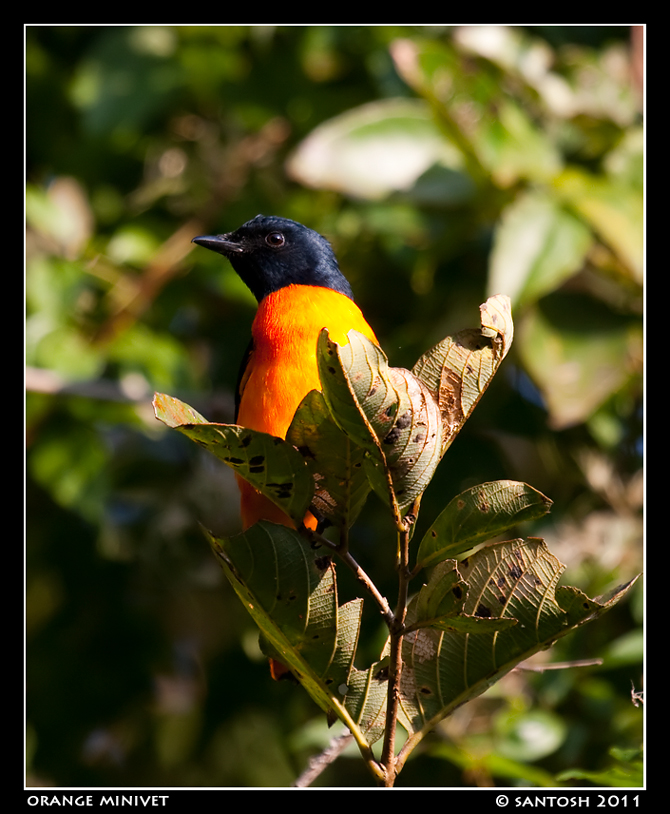
Orange Minivet
Yellow browd Bulbul
Red Whiskered Bulbul
Red Vented Bulbul
Great Tit
Common Iora
Black lored Yellow Tit
Nilgiri Flowerpecker
Greater Flameback Woodpecker
Heart spotted Woodpecker
Common Kingfisher
White breasted Kingfisher
Crested Goshawk
And, as we were just about to leave, we came across this little Green Vine Snake wobbly making its way across, he was very mild and let us click him in patience!
Feb 25, 2011
Ganeshgudi birding trip II
Ganeshgudi Birding II
How to reach – This time we tried out the rail network to reach Ganeshgudi.
From Bangalore to Londa junction (reaches around 6am), trains ply regularly. From Londa either wait for the direct bus service to Ganeshgudi or travel to Ramanagara (10rs on a shared auto) and from there to Ganeshgudi (more bus facilities available).
We did the return journey also in the same fashion reaching Londa and then hopping on a train to Bangalore .
Overall a good option but slightly uncomfortable if you have heavy backpacks and if you want to travel around Ganeshgudi. Well, all transport options do have their pros and cons right? J
The winter had set in, the rains had stopped and the weather was good but 1 thing that plagued us was light… as the sun would come out only past 6:30am and the Old magazine camp having a thick cover of green, it was all the more challenging for photography.
I’m still hunting for the elusive Malabar Whistling thrush that entertains me with its song everytime but never dares to come out in the open! The Great Indian Hornbills are still a distant dream and I’m waiting for my opportunity to sight those endangered birds. The Emerald dove and the Malabar Trogan finally gave up their resistance and presented themselves in front of me their glorious colors and literally put me on a wild hunt to spot them. (It so happened that the Emerald dove eluded me whenever I chased it, but surprised me when I was patiently and silently was waiting for it but preoccupied in other work…!)
Except for the dim light, I had gala of a time birding in and around the JLR Old magazine house campus for 2 days with the help of Joma uncle and Vinay. I should appreciate the staff of JLR camp who help us in all matters and are expert birders, Joma uncle has years of experience and Vinay has got sharp ears and wonderful eyesight. Kudos to the JLR staff and hope they remain the same.
At Ganeshgudi, 6am sharp, I’m up, pick up my camera, come out and seat myself in one of the chairs and the next 15 minutes, sit, acclimatize and listen, listen listen… At this time, the light is very poor and not suitable for photography and I don’t intend to shoot also at this early time. Just sit back and enjoy the early morning songs of the birds around especially the long tunes of the Malabar Whistling thrush. The next 1 hour passes by with the light conditions improving and with my buddies up by this time, we walk around observing the birds going about their daily chores. In this camp water pots are kept at strategic locations that attract a lot of bird that come to drink, bathe and play in the water. It’s a visual treat to watch multiples of them sharing the same tub and also waiting for their turns to the tub. I have had the opportunity to click many birds in and around these tubs be it summer, winter or rainy seasons.
We enjoyed the couple of days with a session of rafting and birding for the rest of the time. The Great Hornbills did not show up as expected and the Malabar Whistling thrush was as elusive and reluctant to come out for us.
We will be back here sometime and hope to catch them all soon :)
Our sightings:
Brown cheeked Fulvetta
Asian brown flycatcher
White bellied blue flycatcher
Blue napped monarch flycatcher
Asian paradise flycatcher
Verditter flycatcher
Red whishkered Bulbul
Ruby throated Bulbul
Yellow browed Bulbul
Jungle Babble
Dark fronted Babbler
Scimitair Babbler
Malabar Whistling thrush
Malabar Trogan
Malabar Pied Hornbill
Indian Grey Hornbill
Emerald Dove
Blue capped Rock thrush
Oriental white eye
Jungle Mynah
Shikra
Purple rumped sunbird
Crimson backed sunbird
Orange Minivet
Eurasian Golden Oriole
Malabar Parakeet
Blue tailed Parakeet
Vernal hanging Parrot
White cheeked Barbet
Coppersmith Barbet
Rosy starling
Heart spotted Woodpecker
Lesser backed Golden Woodpecker
Scaly breaster Munia
Subscribe to:
Posts (Atom)