Showing posts with label j&k. Show all posts

Oct 23, 2016

Dachigam National Park

J&K complete logs here

Early next morning from Manasbahl, we drove straight to Dachigam National Park that is located about 20kms from Srinagar and home to the critically endangered Hangul (Kashmir stag), Himalayan bears and many others. We met Mr. Nazir Malik, one of the finest naturalists I’ve come across who knows Dachigam in and out and has got tremendous knowledge about everything in Dachigam and we were rewarded with some fine knowledge sharing and tips from him.


The park has got a couple of enclosures where bears and a leopard are housed in huge cages that were either rescued or nurtured in captivity since long. Visitors do come in during weekends for picnicking in the park and are taken on a short nature walk inside the park. The terrain in the national park varies from sloping grasslands to rocky outcrops and cliffs owing to the varied altitude variation (5500 to 14000 ft) of the park.

Hangul or Kashmir stag is the state animal of J&K and is found in the national park but habitat destruction and hunting has reduced it to a state of 'critically endangered' on the IUCN list and might be wiped out completely if suitable measures are not undertaken to protect its habitat. I personally feel tourism is pretty low to the park owing to the lackadaisical management of the park, conflicts in the state, and vulnerability owing to the hilly terrains of the park. Himalayan bears are also found in good numbers and there are many incidents of people getting killed/injured being attacked by them. The main thing to be noted here is neither bears or any other wild animals do not attack unless they are provoked or feel threatened or in a act of defense if their young ones are around.


Nazir bhai guided us on a small hike into the immensely vast national park and in that short period of time, we got to see many bird species in about a couple of hours. Chestnut-eared Bunting, Long-tailed Minivet, Tawny Owl, Yellow-billed Blue Magpie, a host of flaura and many species of butterflies kept us enthralled. The afternoon session was a bit downer with a flat tyre and pouring rain but the Tawny Owl seen in fading light brought an end to our wonderful J&K birding trip.

We closed the day, the last of our long trip filled with many moments, experiences, lifers etc watching the football world cup match in Srinagar at Hotel Malik Palace situated overlooking the Dal lake. Next morning I, Kannan and PK were home bound in different flights while Amith had to drive back to drop the car and then catch his flight home a day later.


Closing notes:
First, to thank Amit for detailed planning, shepherding all of us and driving too. Kannan and PK for the awesome company and for many of those moments.
Tips & Notes:
> Have spare days, you never know how the weather can behave especially in the high altitude regions

> Do not rush and exert too much in the high ranges, take it slow and easy
> Manage your bookings only through known contacts or reliable portals, else you may be turned away at the doorstep
> Maggi was the staple diet for us but do try the local food. Keep instant noodles/bread/fruits while traveling to remote places
> Fuel is another precious commodity. Have spare cans on long journey outside of Leh
> Do not under estimate or ignore high altitude sickness. If it strikes, your trip is a complete messy affair. Be aware and take precautions, carry the necessary medications
> Carry sufficient warm wear but do not over stuff; nobody cares if you are wearing the same set daily
> Littering still happens and by all of us. Be sensible and dispose your trash in designated places. Avoid buying unwanted materials
> Help generate local economy – prefer a home stay, hire local guides and cabs, buy local products and help generate revenue


Aug 16, 2016

Tso Kar-Taglang La-Leh-Dras-Srinagar

J&K complete logs here

After the lucky sighting of the Little Owl at the Thupche village and after a quick visit to the monastery there, we were back to the resort for some hot food and much needed rest. The rooms were insulated from the cold winds as they were concrete structures and not tents. I missed pointing out the sightings of Kiang or the Tibetan Wild Ass we had while on our way to Tso Kar from Polokung La. These Ass are found only in pockets in India and this is one place where they are found in huge numbers. In short, you need to come here to see the Kiang, the largest of the Wild Ass species. They are the country cousins of the Indian Wild Ass or Khur that is found in LRK/GRK in the state of Gujarat.


What you get to see here is plain dry fields extending as far as the eyes can see and then the hills and the mountains at the far end rising like the phoenix with ice caps here and there. In the winter months, it’s bitterly cold and snowfall is common around these regions and the lakes freeze. Closer to the resort is Startsapuk Tso, a fresh water lake that houses a variety of birds and that is where we were headed in search of some commonly seen species that included the Tibetan Sandgrouse, Black-necked Cranes, Snowfinches and other water birds.

We had elaborate plans of long birding at Tso Kar, but that somehow didn’t materialize as birding was tough and lady luck not favoring us, still we spent two nights looking out for birds. We missed the very common Tibetan Sandgrouse and the Upland Buzzard was a very distant, far off sighting. We spent the whole day roaming around Tso Kar looking around for birds and we did encounter quite a few of them in good numbers as also the Kiang’s (they run just like that, without any provocation, and keep running). There are no defined tracks to follow (except for those that are carved out due to vehicles regularly moving on the stretch) and our car got stuck in slippery sand at a place and we had our task cut out in getting it out to a safe zone that drained a lot of our energy. It’s not easy spending the extra energy in a high altitude place where every step you take consumes your energy more than that in a normal place.


Black-necked Crane’s, Blanford’s Snowfinch, Twite, Great-crested Grebe, Bar-headed Geese were some of the highlight sightings that we had during the course of the day. Next day, we decided to do some early morning birding and by afternoon start our return journey towards Leh with a definite stopover. Luck, even distant seemed favoring us as we sighted the majestic Golden Eagle yet again (we were seeing it so commonly now all around) and then the rare Saker Falcon (that breeds in these high altitude ranges) and then the Upland Buzzard all in a matter of two hours and that’s how it is. The Golden Eagle had perched on a cliff and was camouflaged pretty well at a distance, the Saker Falcon was perched much higher and far on another cliff and the Upland Buzzard had perched on top of a cliff very far away almost invisible until it flew and we noted the characteristics through the bincoulars.

After having a heavy breakfast and a small photo session, we left as we had to cross over another high altitude pass, Taglang La, where possibilities of sighting the Tibetan Snowcock was presumably high but as luck had it, we didn’t and that made us change our further plans and halt at Rumtse village hoping to sight the rare Snowcock the next morning. It was snowing, chilly and rough weather atop Taglang La and very few people or vehicles around and the roads were missing in many stretches. We stayed at the J&K tourism guesthouse at Rumtse, small but decent accommodation with manageable food cooked for the night. We roamed around Rumtse village (a very small one indeed), looking out for birds and to call up our respective families as mobile network was nonexistent and I and Amith drove up to see some gompa’s closer nearby while PK and Kannan took a long stroll for some more birding.


Early next morning, we spent good time driving around Taglang La but as luck would have it, we didn’t see any signs of Snowcocks and the weather too was not very favorable towards us. We saw the Bharal’s again on the snow clad hills and quite a lot of Wooly hares all around. We started our return journey stopping whenever any of us would sight a bird at a close proximity or at a distance. Kannan and I alternatively stole winks sheepishly under the pretext of looking out for birds as we had nothing to do on the long journey but sit and wait for something to show up. In one such instance, we hit a bounty at a place where we abruptly stopped and were rewarded with sightings of Mongolian Finch (that’s a rarity!), Great Rosefinch, Twite, Chukar Partridge and Fire-fronted Serin’s all closer to a village called Lato, a splendid natural treat for Kannan on his birthday. From there, we headed to Leh with couple of small stops in between and by the time we figured out the location of the army camp and settled, it was late.

Some shopping, dinner and we were back to the camp for much needed rest; our final day at Leh as early next morning we would be heading back towards Srinagar with a halt at Drass. We checked out early in the morning with a quick stopover at the small lake near the airport to have a re-look for any good sightings and then proceeded towards Drass. En-route, we saw a short deviation towards Alchi monastery and decided to pay a quick visit to the place where we were rewarded with sightings of Pied Wheatear and Oriental Turtle Dove and were treated to some finger licking hot Maggi that was much needed. We reached Drass by late afternoon enjoying the vistas all along the way and catching up on some sleep while Amith was doing the hard work of driving.


We were back at the army camp and a break is a good while traveling between Leh-Srinagar as it’s a long journey and those mountain roads to negotiate. Later in the evening while chatting around dinner time, we were advised to start early, very early next day to cross over the dreaded Zojila at the earliest and we followed it and were happy as it turned out to be a messy stretch, much worse than what we encountered while coming. We left Drass around 4 in the morning only to be stopped at the check post before Zojila as the weather conditions were unfavorable that we soon realized. A little while later, we were allowed to pass along with few other cars (only smaller vehicles were allowed) and soon unfolded the gravity of the situation as the roads were only slushy and were becoming hard to negotiate.

Just passing through the Zojilla, Amith’s keen ears picked up a few dogs barking incessantly a little away on a slope to our far right. The voices of bear, bear started resonating in the car as we jolted to a sudden halt and all eyes wandering around the barking dogs. Soon, a bear (the debate of it being a brown or a black Himalayan bear is still on) emerged on the slope while the dogs continued their barking surrounding the bear as the nomadic settlement from where the dogs arrived was close by. We guessed some action to happen but the bear was eager to get away while the dogs content in chasing it away. After 10 good minutes and the bear appearing to move away, we resumed our journey as we still had to steer clear of the slushy Zojila at the earliest. By now we were the only vehicle left as the other vehicles had passed us and with a constant drizzle and unwilling sun to shine, it was a tricky good hour we spent to cross the entire Zojila stretch, all eyes wide open and pepping Amith with F1 style navigation.


We halted at Sonamarg for lunch and a quick walk around the park near the river that was full owing to copious rains over the last couple of days. Soon, we got to know that entry to Srinagar was banned as a curfew was on owing to PM’s visit to the place. Having heard that, we now had the task of finding a place to halt for the night and after some intense searching, we ended up at Manasbahl, about 20kms before Leh. Luckily it worked out well for us as we got to sight the Little Bittern, Jackdaw, Black-eared Kites in the small lake at the same place. Later, we mingled with the locals and for discussions on various topics till we chose to end the day.


People in Kashmir, like any of us are peace loving and would love to remain the same and something more evident was their reluctance to travel anywhere as lot of questions about militancy, war crop up wherever they go that makes them feel uncomfortable. A cozy little homestay where we stayed near the lake; good but expensive food; hospitable host who was very friendly; elderly locals who were more than keen to indulge in discussions on various topics made our short stay a memorable one.

Feb 19, 2016

Pangong Tso - Chumathang - Sumdo - Tso Kar

J&K complete logs here.


After surviving the howling winds and a chilly night, I pulled up myself to step out and have a look at what was on offer. The campsite was facing the lake and vista views of the lake and the rising sun was what awaited us (well, actually the sun was up very early when we were in deep slumber). The howling winds had reduced and so did the chillness and the sun was blazing in all his might with clear skies.


We drove up to Mann (few kms further away) for some birding and all I did after looking at the birds was just sit and get lost in the tranquility and surrender myself to the sublime beauty of the place next to none. I didn’t know what to do, I was completely lost and felt like a puny, tiny object on this earth in front of the mighty Himalayas and the widespread blue mesmerizing Pangong Tso.


By now, the sun was blazing with all his might and it was getting hotter by the hour and all I could manage to do was sit on the ground and stare into oblivion, a feeling of being in a place that is imaginative or was I hypnotized with a blank mind staring at the natural vista or was I out of my mind thinking all these…

A good hour passed by with me in this state of mind till the other folks returned and brought me back to the real world and the after effects of this state of my mind continued as I chose to remain a silent spectator till we moved out of this place.


This lake and some specific locations here have become tourist hotspots after the movie 3 Idiots and as a result of it, you’ll find signs of trash, hordes of people on a ‘picnic’ and the exhibit of insensitivity that we display everywhere.

After a dose of simple breakfast and birding around, we left Pangong towards Tso Kar, another high altitude lake and the place for the critically endangered Black-necked Cranes but we were sure of a halt in between due to numerous birding opportunities we would encounter on the way. We had to take the route backwards via Chang la and then deviate towards Karu and then Chumathang. It was already late afternoon by the time we reached Chumathang and opted to stay there and continue further the next day. We chose a small hotel to stay right next to the highway that was probably the only hotel around that offered a place to stay. There were some natural hot springs within the compound area from where hot water bubbled out even in the extreme cold. These regions in Ladakh are not so frequented by tourists and in many stretches, ours would be the only vehicle to be moving around. Wherever and whenever we stopped on seeing a bird, we would be curiously watched by the locals around and our cameras and binocs would be their main discussion theme.


Next day, we left early towards Sumdo as we had a lot to cover and had some prime birding spots en-route that had plenty to offer. We had plenty of birding on the way till we reached Upper Sumdo where again we were kept occupied by relentless birding all around. Except for a few houses, there was nothing much in Upper Sumdo but the bird life kept us occupied. In particular, the White-throated Dipper that gave us a hard time at Mushko valley was frittering all around the place here and spent ample time with us allowing to observe its behavior, feeding pattern and also gave us the opportunity to take some good shots of it from multiple angles.


We also came across a herd of Blue Sheep or Bharal that had come down from the hillocks to feed on the lush green grass and they showed us a glimpse of natural talent of maneuvering cliffs and rock climbing skills. In seconds, they would vanish from our sight and be seen on a steep cliff high above and their ability to merge within the surroundings keeps them safe from the lurking predators. Bread, Jam, Nutella and Ready-to-eat dry Noodles was our breakfast that we had in midst of the continuous birding that we were doing.


From Sumdo, we drove towards a school at Puga, where there were a couple of bird sightings reported and also offered a lift to a teacher from that very school who was very happy when we agreed to drop him. As luck would have it, we were blessed with distant sightings of the Black-necked Cranes and Tibetan Wolves en-route Puga that literally had us thanking all our stars and gods that we pray to. We were confident of seeing the Black-necked Cranes, but Tibetan Wolves was a bonus that we were rewarded. They were sighted in a distant meadow near a hot spring and we chose to stay till the wolves and the cranes moved away from there. Our effort of having embroided t-shirts from Leh with the cranes paid off as we could now happily state that we had indeed seen them.


From Pugo, we traveled towards Tso Kar through another pass, ‘Polokung la’ on a literally non-existent road with an ascending gradient and except for a single vehicle we didn’t pass by any other vehicle on this stretch for the many hours we spent traveling. Polokung la had multiple sightings on offer for us as we got to see the Groundpecker, Bearded Vulture, Golden Eagles, Ravens and many others and the Groundpecker being the highlight of the place.


We reached Tso Kar Eco resort just before Thupche village that looked deserted passing by Tso Kar and blessed with another sighting of the Black-necked Cranes. The Eco-resort is mainly a club of few individual rooms and one dining hall and nothing else. The temperature was dipping as the hour passed by and we raced to the village to scout for the Owl species found there and after a thorough scanning we did see the Little Owl happily perched on an electric pole.

Back to the eco resort after this, we had a proper meal and retired for the day with plans of extensive birding around Tso Kar the next day. The accommodation was decent and comfortable and these being concrete buildings helped negate the howling winds. We were in a far fetched location, literally cut off from the world with patchy or non-existent network and the only news that would reach here was the communication received through the satellite phone booth.

(how many Bharal's can you see...?)

So overall we had good sightings for the day that included Blue sheep, White-throated Dipper, Black-necked Cranes, Tibetan Wolves, Groundpecker, Lammergier, Little Owl, Ravens, Royals Pika and hot springs at Chumathang.

Feb 7, 2016

Leh - Chang La - Pangong Tso

J&K complete logs here.


Further to what I had said in the earlier post, below is an Alpine Accentor, found in the high altitude region feasting on a noodle nibble discarded atop Khardung La. Polluting here is an serious issue and we all are responsible for it. Our way of contribution was to carry back our trash/plastics from such places to the nearest town for disposal.


After navigating the terrain twice through the mighty Khardung La, we got our vehicle checked once more before proceeding towards Pangong Tso and Tso Kar lakes as now the travel would be through remote places with fewer people and fewer facilities. Also, point to note is that you may need to carry additional fuel in cans if your travel is for more than 2 days from Leh, else you might face the probability of getting stranded in a no man’s land till you are rescued and in that eventuality, the highest possibility is of being rescued by one of those army truck convoys that keep moving between bases.


With the vehicle check getting delayed, we utilized the time to do some shopping and finally headed towards another high altitude pass, the mighty Chang La, world’s third highest pass located at 17688 FT. It was a long journey and we had multiple breaks on the way to gaze at some birds or to drink in the scenic views that was on offer. Stops for food/drinks was very limited and we had quite a long distance to cover before ending the day.


Birding on the way, we finally reached the top at around 3pm; quite late actually and stopped for a quick scan for the birds and to have the much needed Maggi in lieu of lunch that we had skipped. Compared to Khardung La, this pass is relatively less crowded and less noisy as most of the vehicles that pass here are the ones traveling to the remote Pangong Tso.


Snowfinches, Rosefinches, Accentors, Ravens, Choughs kept our binocs and cameras occupied till Chang La and thereafter a lone Red fox, numerous marmots and a few woolly hares kept us happy. The roads were pretty good except for few stretches here and there and we were soon approaching the magical lake, Pangong Tso. As stated earlier, there were hardly any souls or people moving and we were kind of traveling in isolation. A vehicle or two would pass us once a while, else it was only ourselves in the whole terrain. No people, no shops, no food, no water… absolutely nothing. You just keep following the dirt track till you reach your destination and in case you are stuck somewhere, keep praying that someone should find you!


Daytime in the mighty Himalayan region is lengthier and it used to get dark only post 19:00 hours, and this meant we had long days every day, wake up at odd hours in the morning and hit the bed late at night that meant only a few hours’ sleep every day literally. As we started descending towards Pangong Tso, we could clearly see the crystal clear blue lake from a far distance and the views were amazing, difficult to describe but worth experiencing. A huge fresh water lake at a high altitude of about 15000FT, 30% of it in Indian territory and the rest 70% in Tibet. The 30% of the lake that is in India itself is mighty huge and there are camps setup at strategic points for hosting the tourists. Choices vary from luxury to very basic and the food served across is almost the same. These camps wind up by October as the cold starts getting unbearable and they return back next summer just before the tourists start arriving. During winter, the whole lake is frozen and only a few hard souls choose to stay back in the area.

We had to do a little bit of searching and enquiring for accommodation and finally chose to stay in tents at Padma Hotel, a setup of cluster of tents and a small building for the host. We were walk in guests and luckily got some dinner and we feasted as we were without a proper meal through the day. Sleeping in tents in the bitter cold is a challenge and I had to use multiple layer of clothing and bedspreads to feel comfortable. In such cold weather, your activity freezes and you don’t feel like doing anything other than snuggling up in the bed.


Pangong and Chumathang up next…

Jan 31, 2016

Khardung La-Panamik-Leh

J&K complete logs here.


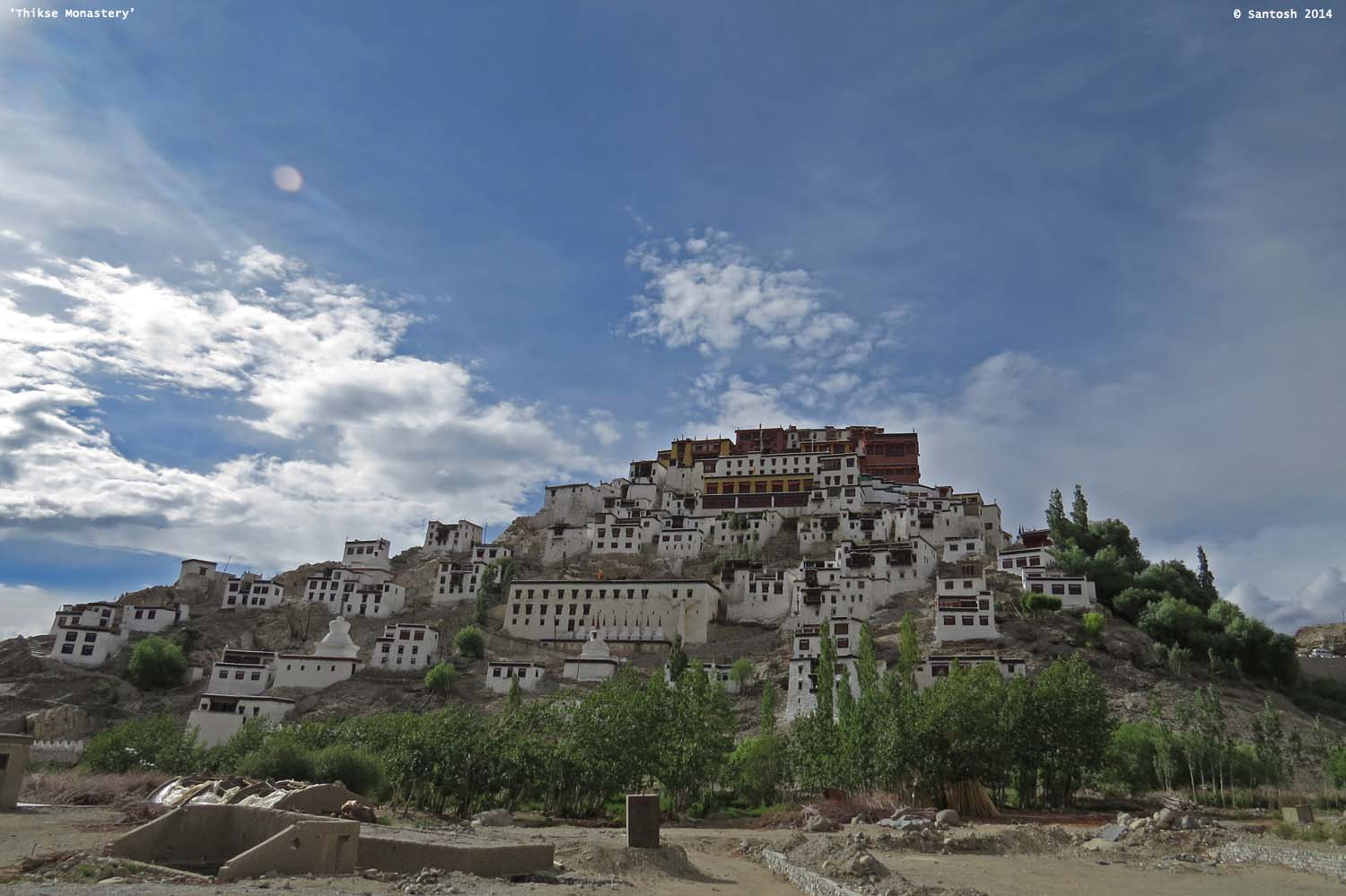
We took a day off after arriving in Leh, a little tired of the long travel done so far and we used the day to acclimatize and look around Leh and we also had to get the vehicle checked. Thikse monastery was the only place we visited in Leh and we couldn’t manage any other sightseeing. Next day would be a big day as we would be traversing through Khardung La. We also utilized the spare day to do some shopping, pick up essentials, fill up the vehicle tank and get the permits (just in case if it is asked for somewhere).


[Idol inside the monastery (top) and view from the monastery (above)]

Next day, we were up early and all set to traverse through the highest motorable road in the world situated at an altitude of 18380 FT! Our plan was to reach Panamik from Leh passing through North Pulu, Khardung La and South Pulu.


Khardung La is a hot spot for tourists, especially bikers who ride in all kinds of bikes (bullets are invariably the preferred choice); stay on the top for a while and either proceed back or halt at Panamik. High altitude has its problems and for people not used to heights, precaution needs to be taken else you could easily be affected by the High Altitude Sickness that in extreme severity can lead to death.

As we left Leh, the roads started winding up gaining altitude and we could see wonderful vistas of the Leh town with the mighty Himalayas in the background. All these hilly terrain roads are maintained by the BRO (Border Roads Organization) and they have people and equipment at strategic locations that is called in whenever required. Also to note, all these are strategically important locations as our neighbors are just across the mountains and the roads need to be kept clear if any immediate troop movement needs to happen.


Driving up to Khardung La is an experience in itself and the vistas you see blow your mind away. For a person like me, who had never experienced a snowfall or a hailstorm; this trip made me experience all the above and we also had to literally drive on ice-slush kind of tarmac in some places that was quite challenging as well as scary.

Khardung La top sometimes resemble a mini market (of one of our cities) with people coming in hordes (picnickers in my language) and there is not a place there where you don’t see a person taking a selfie or a groupie. A small eatery on top offers the much required snacks and a bowl of Maggie if you are really hungry. Yes, Maggie has been a lifeline for people living in such hostile conditions and also travelers visiting them as it’s the quickest and easiest to prepare and it provides you the much needed energy to withstand the cold and fill up your stomach.


We did not directly drive to the top, but took it easy stopping en-route for our customary birding and slowly drove up. We found more birds scavenging on the litter discarded on the top and we could see them feeding on Maggi from a plastic sachet at 18380 FT. Plastic is strewn from the sea depths to the highest mountain tops! After our birding, we had some quick hot Maggie followed by a cup of hot tea to keep us warm and active. Temperatures atop Khardung La is usually in the single digit or in the negative and any individual needs to be prepared for the harsh weather up there. We recorded temperature of -1degC atop Khardung La, the lowest on our entire trip.


Note of Caution: Passing/Driving through high altitude mountain passes is an adventure in itself but one needs to take some precautions before venturing out on the same. Normal human beings get affected by the sudden altitude change and drop in Oxygen levels and it becomes harder to breathe and move around. It is advised not to ‘overstay’ atop Khardung La for more than 20-30 minutes as Oxygen levels are low and it can affect an individual’s health. But, we the ignorant people tend not to follow the advisory and end up suffering. We could see quite a few people visiting the mobile army hospital atop Khardung La for rest and in some cases for some Oxygen intake. Knowing the risks, we were well prepared and informed and acted accordingly. Also advised is to intake lots of water to keep your body hydrated in the cold weather. 


Coming back, how does it feel to be atop the world’s highest motorable road where only a select few visit and as a bounty, we were also treated to some wonderful bird sightings along the way! Finches, Redstarts, Wooly Hares, Bharals were some of the sightings we had along the way. Soon, not to overstay we descended down towards South Pulu on our way to Panamik and a bounty sighting awaited us as we located a Golden Eagle majestically perched atop a rock cliff just beside the busy road. Soon, we realized there were more and finally saw 4 of them together… they were having a feast and we were enjoying the siesta! Amith and PK had a far off sighting of this majestic raptor with difficulty in the Spiti valley and here we were watching 4 of them together and that’s what we call luck.


The road through Khardung La that further passes through Panamik is a strategically important route as it further leads to Siachen (the dispute area with Pakistan) that is a very important post for our armed forces and regular troop movements happen along this route. Interestingly, many vehicles (trucks, bikers, cars) that get stuck in the ice-slush or have a breakdown are mostly rescued/helped by the army personnel moving in their heavy trucks.

As the roads were brilliant, we reached Panamik quicker than expected sighting a herd of Bacterian camels far off in the horizon on the way and at Panamik we started scanning the area for a single bird that we had come in search of. Well, yes we had come to Panamik just to see that one single tiny little bird. Amith and Kannan got fleeting views of the bird before we called off for the day sprinkling hopes for a better sighting the next day. For our stay at Panamik, we walked into a no-name not-yet-completed building looking for accommodation and we got it but on the flip side there was no electricity in the guesthouse. Huber lodge was the name of the place and we caught up with two expat bikers who had come riding from Manali.
Soon, next morning we were up early and out scanning the area looking for that small bird that goes by the name 'White-browed Tit Warbler' that is just about 10cms in size. This small little bird, belonging to the warbler family is generally skittish in nature like other warblers and is constantly on the move and catching a clear sight of them is difficult. This individual kept us on our toes and gave us glimpses only for seconds while on the move.


With our mission accomplished, the rest of the group went on to visit the famed hot springs of Panamik while I stayed back to catch up on some sleep. On our return journey, we were to pass through Khardung La pass again birding along the way and also gave a lift to a Buddhist monk, who incidentally resides at the Tibetan camp near Kushalanagara in Karnataka. Our hopes of an early return were squashed as we got to know that Khardung La stretch was closed due to fresh snowfall and they were not sure when that would be cleared. We were advised to rest for the day and continue in the morning. After waiting for an hour, we scouted for options to stay at South Pulu and we found it but somehow were not convinced with what was on offer and the price quoted.

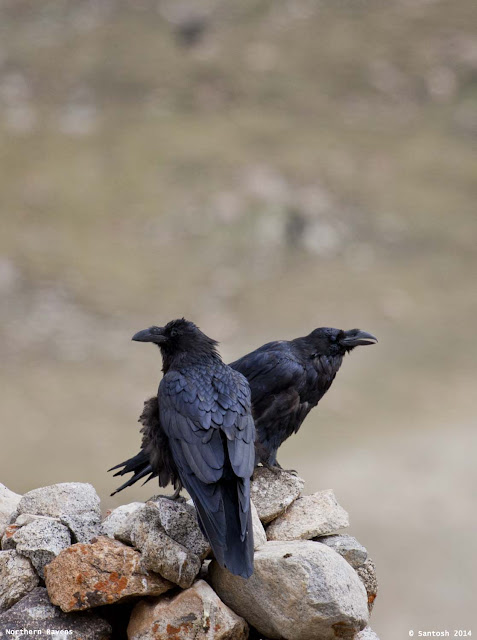

Dilly dallying, we pursued one last attempt to check if the roads were cleared and proceeded towards the check post as we still had an hour to go for daylight to vanish. The person in charge replied in the affirmative that yes the path was cleared for light vehicles to pass through and three other cars that were lined up along with us were clubbed and told to travel as a convoy staying together. We jumped at the offer and started our travel towards Leh. We soon realized why the stretch was closed and in some places there was no signs of the road at all. The weather was worse than the previous day and was showing no signs of improvement and Khardung La looked deserted with hardly few vehicles up there owing to the bad weather. Some moments were scary, but we were cautious and passed through eventually in dimming light. Rosefinches, Snowfinches, Redstarts, Chukar Partridges, Punjab Ravens, Golden Eagles and the mighty Lammergier were some of our sightings all through the day. Back at Leh, we stayed at the same lodge, Hotel Dorjee and hit our beds for some good rest as we were to travel to one of the most beautiful high altitude lakes, Pangong Tso, the next day…